Karate has many different kata, but among them Naihanchi is considered one of the most important.
Naihanchi is a kata designed to cultivate the fundamental movements and principles that form the basis of karate, and it is regarded as essential for understanding the deeper techniques and inner teachings of the art.
Here, we will explain the characteristics of Naihanchi and examine the actual movements of the kata.
Naihanchi: The Starting Point of Karate Training
Naihanchi is one of the most fundamental kata in karate and has long been taught to beginners. As the saying goes, “Karate begins with Naihanchi and ends with Naihanchi.” In this sense, Naihanchi represents the starting point of karate training and serves as an essential foundation for anyone who studies the art.
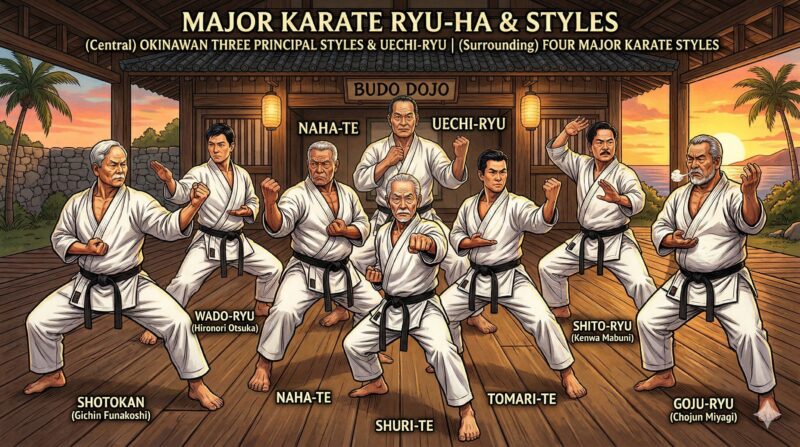
In particular, in the traditions of Shuri-te and Tomari-te, Naihanchi has long been regarded as the first basic kata that students should learn, and it has been highly valued throughout history. In some schools, the stance used in this kata is specifically referred to as the “Naihanchi-dachi,” and it is distinguished from the kiba-dachi (horse stance), with the latter generally requiring the hips to be lowered slightly more.
Historically, for karate practitioners in the Shuri and Tomari regions, Naihanchi was passed down and practiced as the foundation of karate training. Chibana Chōshin, the founder of Kobayashi-ryū, also learned Naihanchi from Itosu Ankō and used it to refine his fundamentals. Although Itosu later created the Pinan kata as part of physical education karate, it is said that he nevertheless continued to teach Naihanchi with great importance.
Similarly, Gima Shinkin of Shotokan lineage studied Naihanchi during his time at the teachers’ training school under both Itosu and the military instructor Yabu Kentsū, and he practiced diligently with it as the basis of his training. In short, there is little doubt that Naihanchi is an indispensable kata for building the fundamental principles of karate.
The History of the Naihanchi Kata
According to Motobu Chōki, Naifanchi was one of the kata that had existed since ancient times, but it is said that it had already been forgotten in China. According to one legend, a Chinese man who temporarily stayed in Tomari Village transmitted Naifanchi there, although the authenticity of this story remains unclear. However, since Motobu wrote in detail about Matsumura Sōkon’s Naifanchi, it can be inferred that by the early nineteenth century the kata was already widespread in the Shuri region, or had at least been established there.
In Tomari Village, it is said that Matsumora Kōsaku (1829–1898) first learned Naifanchi from Uku Pechin Yoshitaka (1800–1850). Since Uku died in 1850, if this tradition is accurate, Matsumora must have learned Naifanchi no later than the 1840s.
There is also a legend that Itosu Ankō first learned Naifanchi from a castaway named Channan (Zen Nan) who had temporarily stayed in a cemetery in Tomari Village. However, this account contradicts the fact that Itosu’s teacher, Matsumura, was already teaching Naifanchi. For this reason, it is likely that some of the details regarding the people involved or the historical period were inaccurately transmitted over time.
Technical Characteristics of Naihanchi
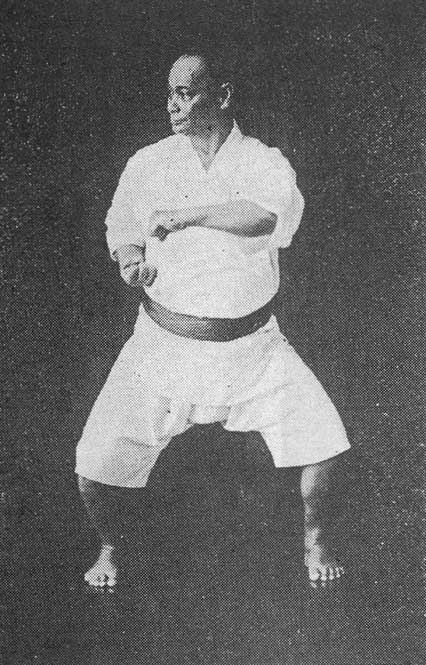
One of the most distinctive features of Naihanchi is that it is composed entirely of sideways movements. While many karate kata involve forward and backward stepping, Naihanchi focuses primarily on movement to the left and right, with offensive and defensive techniques unfolding along this lateral line. This characteristic is sometimes said to reflect combat in confined spaces, suggesting that the kata contains practical techniques for fighting near walls or within a crowd.
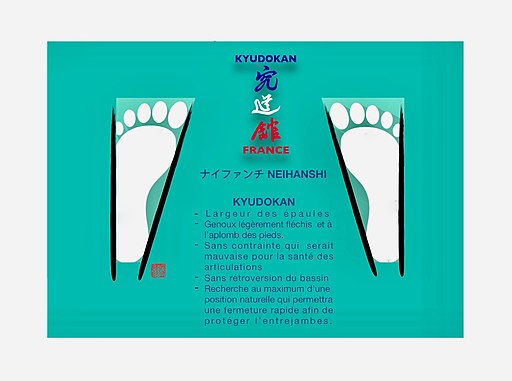
Naihanchi also employs a distinctive stance known as Naihanchi-dachi. In this stance, the feet are placed apart to the sides, the knees are drawn inward, and the hips are lowered, creating a stable and firmly rooted lower body. This posture provides strong resistance against lateral force and allows practitioners to execute strikes and defensive techniques effectively through the use of the core body.
Furthermore, in the practice of Naihanchi, particular emphasis is placed on characteristic body mechanics of Okinawan karate, such as the use of the hips (gamaku) and the momentary tightening or focus of the body (chinkuchi). These are not simply matters of muscular strength; rather, they are methods of generating power by coordinating the entire body as a single unit. As such, they are essential elements for understanding the fundamental principles of karate.
In this sense, Naihanchi is not merely a basic kata, but can be regarded as a form that condenses the core body mechanics and combat principles of karate. For this reason, even advanced practitioners have traditionally continued to practice Naihanchi repeatedly, using it as a means to refine and revisit the fundamentals of their training.
Conclusion
At first glance, Naihanchi may appear to be a simple kata with limited movement. However, within its techniques are contained many of the essential elements of karate, including fundamental body mechanics, methods of generating power, and principles of offense and defense based on practical combat.
Through lateral movement, a firmly rooted stance, and the characteristic Okinawan body mechanics such as gamaku and chinkuchi, practitioners learn how to generate power in a natural and integrated way. For this reason, Naihanchi has long been valued not merely as a beginner’s kata, but as an important form for understanding the core principles of karate.
As the saying goes, “Karate begins with Naihanchi and ends with Naihanchi.” In this sense, Naihanchi represents both the starting point of training and a fundamental form to which even advanced practitioners must continually return. By practicing it repeatedly, one gradually comes to understand the deeper meaning of its movements and the proper use of the body.
In this way, Naihanchi is a kata that embodies the history, techniques, and philosophy of karate, and it remains an indispensable form for anyone who seeks to truly understand the art.
※A document featuring illustrated explanations of the fundamental karate movements “Fukyugata” and “Naihanchi,” which are widely practiced across various karate styles, is available for sale on Gumroad. It also explains differences in terminology and variations in kata among different karate schools, making it a useful reference for deepening one’s understanding of karate.